


What are the benefits of a doctor-led skin clinic, beyond the label itself? If you’re considering aesthetic treatment, it’s reasonable to want clarity about who assesses your skin, how a recommended procedure relates to your goals and what clinical oversight involves.
A considered medical assessment can connect your concerns with relevant options and identify when a treatment may not be the right fit. At Skin Project Clinics, a physician-owned and operated cosmetic and skin clinic in North Sydney, experienced cosmetic doctors perform non-surgical aesthetic treatments. The discussion is tailored to individual goals, rather than a one-size-fits-all recommendation.
This article explains how doctor-led care can shape assessment, treatment discussions and follow-up, and what to look for beyond marketing language. You’ll learn what a thoughtful consultation may cover, how clinical reasoning can differ between injectables and laser procedures, and how to approach treatment with realistic expectations. This context can help you make a more informed decision about care in North Sydney and nearby areas.
Key Takeaways
- The benefits of a doctor-led skin clinic centre on clinical reasoning, individual suitability and thoughtful oversight, not the label alone.
- Your concerns, medical history, goals and expectations can inform which treatment options are discussed.
- Compare aesthetic care settings by how assessment, planning and treatment decisions are handled, rather than assuming outcomes based on provider category.
- A considered consultation makes space to discuss expected effects, risks, limitations and aftercare before agreeing on next steps.
- Skin Project Clinics provides doctor-led aesthetic care in North Sydney, with experienced cosmetic doctors performing non-surgical treatments.
What Are the Benefits of a Doctor-Led Skin Clinic?
The benefits of a doctor-led skin clinic come from the clinical reasoning behind each decision, not simply from using “doctor-led” as a label. Here, doctor-led care means a doctor is involved in the clinical assessment and treatment decisions. That involvement can help connect your concerns and goals with options that may suit you, rather than assuming one procedure is right for everyone.
It’s a considered approach, not a promise of a particular result. A doctor’s involvement doesn’t remove all treatment risks, and outcomes can vary between individuals. The value is having your suitability, expectations and options considered as part of a medical discussion, with room to decide whether proceeding makes sense.
What does doctor-led mean in an aesthetic skin clinic?
The phrase should describe how care is delivered, rather than function only as branding. A doctor’s role may include assessing your concerns, discussing possible approaches and guiding treatment decisions. Responsibilities can differ by procedure and must align with current Australian professional guidance. For context, Dermatology is a medical specialty focused on the skin, hair and nails. Cosmetic skin care and dermatology are related, but the terms aren’t interchangeable.
At Skin Project Clinics, experienced cosmetic doctors perform non-surgical aesthetic treatments, including injectables, thread lifting and laser procedures. Doctor involvement can make the discussion specific to your circumstances. The same concern may call for different options depending on the person, and treatment may not be appropriate if it doesn’t align with their goals or circumstances.
Who may value a doctor-led approach?
If you’re considering injectables, thread lifting or a laser skin procedure for the first time, you may value having a doctor explain what an option is intended to address and where its limitations lie. A consultation can also help you pause before committing to a treatment you’ve seen promoted or recommended elsewhere.
This approach may also suit people with several concerns who aren’t sure which to address first. A clinical discussion can put those concerns in context and clarify whether a proposed treatment is consistent with your goals and expectations. It may lead to a treatment plan, further discussion or a decision not to proceed. Considered care supports an informed choice, rather than treating every consultation as a step towards a procedure.
How Medical Assessment Can Shape Skin Treatment Decisions
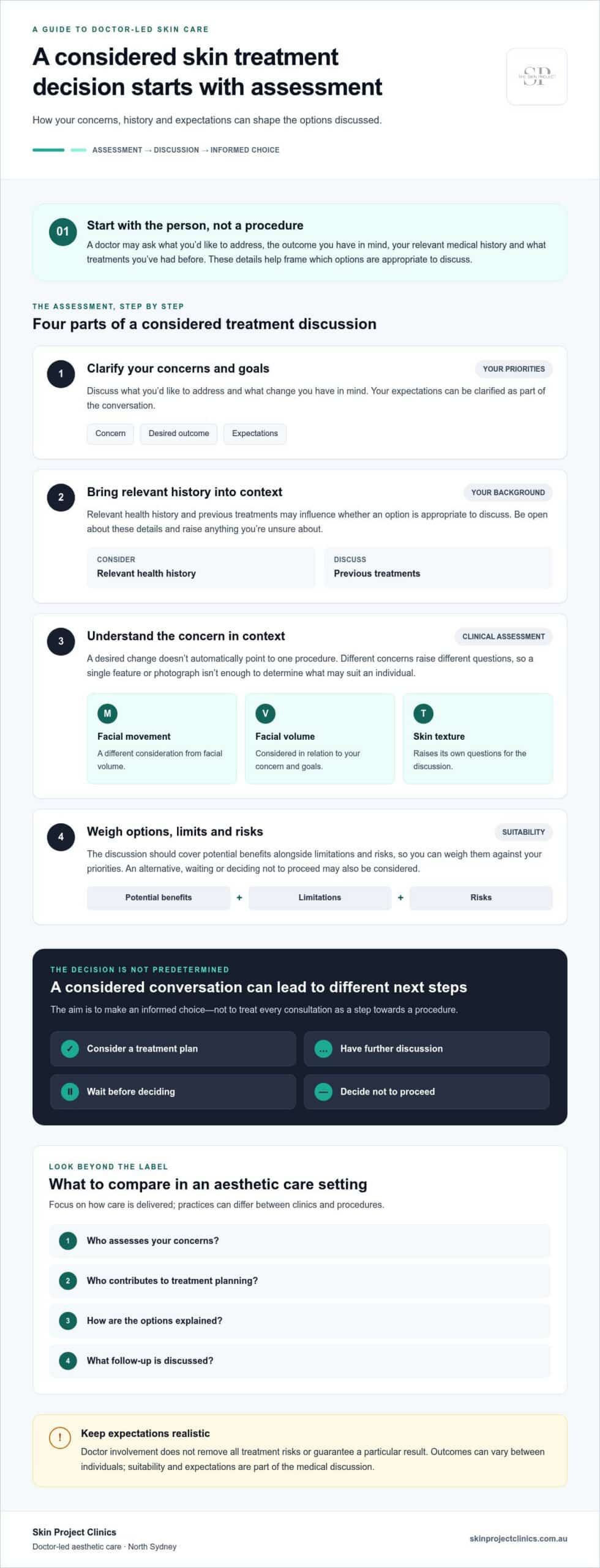
A treatment discussion should start with you, not a procedure. A doctor may ask what you’d like to address, what outcome you have in mind, your relevant medical history and what treatments you’ve had before. These details help frame which options are appropriate to discuss and what expectations may need clarification.
Individualised treatment planning means using a person’s goals, clinical assessment and relevant history to guide a discussion of suitable options, without promising a particular result.
How goals and anatomy inform a treatment plan
A desired change doesn’t automatically point to one procedure. Facial movement, for example, is a different consideration from facial volume; skin texture raises other questions. A doctor can assess these factors in context and explain why different approaches may be discussed. A single feature or photograph isn’t enough to determine which treatment is suitable for an individual.
Skin characteristics can also change over time. The National Institute on Aging describes changes that may occur as skin ages, offering background on why assessment should consider the person’s skin rather than rely on a standard plan. The aim is to relate your concern to the options under discussion, not to assume a particular treatment will suit everyone.
Why treatment suitability matters
Medical context can influence whether an option is appropriate to discuss. A doctor may consider your relevant health history, previous treatment and expectations. Be open about these details and raise anything you’re unsure about. The discussion should cover potential benefits alongside limitations and risks, so you can weigh them against your priorities.
Sometimes that conversation leads to considering an alternative; sometimes it leads to waiting or deciding not to proceed. That isn’t a failure to make a plan. It’s part of making a considered decision, rather than choosing a procedure simply because it’s familiar or popular.
For a procedure-specific example, read this clinical guide to anti-wrinkle injections. It can help you prepare questions about how a treatment is discussed in relation to your goals. The Skin Project Clinics website provides more information about the clinic’s doctor-led aesthetic care in North Sydney.
Doctor-Led Skin Clinic vs Other Aesthetic Settings: What Is Different?
“Doctor-led” describes a care model, but the label alone doesn’t explain how treatment decisions are made. A useful comparison looks at the process: who assesses your concerns, who contributes to planning, how options are explained and what follow-up is discussed. Practices can differ between clinics and procedures, so broad assumptions about skill, safety or results aren’t helpful.
The benefits of a doctor-led skin clinic are best understood through the clinical involvement you actually experience, not as a guarantee that a treatment is suitable or will produce a particular result.
What to compare beyond the clinic label
Use these points to understand how care is organised. The comparison describes possible processes, not fixed rules for every clinic or practitioner.
| Care aspect | Doctor-led model | Other aesthetic setting |
|---|---|---|
| Assessment | A doctor is involved in assessing the patient’s goals, skin and relevant medical context. | Assessment may be undertaken by a different practitioner, depending on the setting and procedure. |
| Planning | The doctor contributes to discussing options and guiding treatment decisions. | Planning arrangements vary; understand who contributes and how the recommendation is reached. |
| Discussion | The conversation can address potential benefits, risks, limitations and alternatives in relation to the individual. | The level of detail and who explains each aspect can differ between settings. |
| Follow-up | Next steps can be discussed in the context of the treatment and the patient’s needs. | Follow-up arrangements vary by clinic and procedure; they need not be identical for every treatment. |
Professional titles and responsibilities depend on the practitioner’s role and the procedure involved. In Australia, current guidance should inform how these terms and responsibilities are understood. A clinic’s language is less useful than a clear explanation of who assesses you and how decisions are made.
How clinical involvement can vary by treatment
Different procedures raise different planning questions. For injectables, the discussion may consider the treatment area, facial movement and your aims. For a laser skin procedure, skin characteristics, preparation and aftercare may be more prominent. The procedure influences what needs to be covered; one assessment template won’t fit every treatment.
For a procedure-specific example, read this clinical guide to Fraxel laser treatment. At Skin Project Clinics in North Sydney, experienced cosmetic doctors perform non-surgical aesthetic treatments, with options discussed in relation to individual goals. Doctor involvement supports a considered discussion, but it doesn’t remove treatment risks or determine the right choice for every patient.
What to Expect From a Doctor-Led Skin Clinic Consultation
A consultation is a chance to explain what you’d like to address and understand whether an aesthetic treatment may suit your goals. The discussion should be measured, with time to ask questions and consider the information before deciding whether to proceed.
Preparing for a useful clinical discussion
You don’t need to arrive with a treatment already chosen. A few notes can help you make the most of the conversation:
- Your main concern: Identify what you’d most like to discuss and the change you hope to achieve.
- Your medical context: Share relevant medical history, current medicines and previous aesthetic treatments with the treating doctor.
- Your questions: Note what you’d like to know about options, expected effects, risks, limitations, recovery considerations and follow-up.
Being clear about your expectations matters. It gives the doctor a better understanding of what you’re seeking and helps frame a realistic discussion about possible next steps.
How treatment options and next steps are discussed
The consultation can follow a practical sequence: discuss your concerns, assess whether treatment may be suitable, explore relevant options, then agree on what happens next. The doctor can explain how potential approaches differ and outline their limitations. A treatment recommendation should be considered in light of your goals and circumstances, not treated as a guaranteed outcome.
Ask about benefits and risks, what the treatment may not address, and what aftercare or follow-up may involve. These details can vary by procedure, so the discussion should relate to the option being considered. If something isn’t clear, ask for it to be explained in a way you understand.
Consent is part of making an informed decision after relevant information has been discussed. You can take time to consider your options; agreeing to a consultation doesn’t mean you must proceed with treatment. Waiting or deciding not to go ahead is also a valid next step.
The benefits of a doctor-led skin clinic include having treatment choices discussed in the context of an individual assessment, while keeping expectations grounded. At Skin Project Clinics in North Sydney, experienced cosmetic doctors perform non-surgical aesthetic treatments and tailor options to individual aesthetic goals. If you’d like to discuss your concerns and possible next steps, you can book a consultation with Skin Project Clinics.
Choosing Doctor-Led Skin Care in North Sydney: A Considered Next Step
The meaningful distinction in doctor-led aesthetic care is how clinical reasoning guides individual decisions. A clinic label alone can’t tell you whether a treatment fits your goals or what to expect. A considered discussion puts your concerns, relevant medical context and possible options in perspective, without promising a particular result.
How Skin Project Clinics approaches aesthetic care
Skin Project Clinics is a physician-owned and operated cosmetic and skin clinic in North Sydney. Experienced cosmetic doctors perform non-surgical aesthetic treatments, including anti-wrinkle injections, dermal fillers, thread lifting and laser procedures. These treatments involve different considerations, so your goals help shape which options are discussed.
Treatment decisions are personal. Someone considering a change to facial movement may have different questions from a person concerned about skin texture or volume. A clinical discussion can help clarify what an option is intended to address, its limitations and whether it aligns with your expectations. The aim is an informed conversation, not a prescribed outcome.
The clinic is in North Sydney and serves people from nearby communities, including Crows Nest, Artarmon, Waverton, Kirribilli, Lavender Bay, St Leonards, Greenwich, Neutral Bay and Cremorne.
Deciding whether to book a consultation
A consultation may be useful if you’re considering aesthetic treatment for the first time, weighing up more than one concern or unsure whether a procedure suits your aims. Use the discussion to understand relevant options, ask about potential benefits and risks, and consider what happens next. The right decision may be to proceed, explore an alternative or take more time before deciding.
The benefits of a doctor-led skin clinic are grounded in how care is assessed and discussed, rather than a promise that every treatment will be suitable or produce a specific result. At Skin Project Clinics, experienced cosmetic doctors perform the clinic’s non-surgical treatments, with options tailored to individual aesthetic goals.
If you’re ready to discuss your goals and possible next steps, you can book a consultation online. There’s no need to arrive with a procedure already selected. A clear conversation can help you decide whether to proceed, consider another approach or wait.
Make Your Next Skin Care Decision With Confidence
The benefits of a doctor-led skin clinic come from thoughtful assessment and clear discussion, not a guaranteed result. Understanding your goals, relevant medical context and treatment expectations can help shape which options are considered. A useful consultation also makes space to discuss potential benefits, risks and limitations, and to decide whether to proceed, consider alternatives or wait.
In North Sydney, Skin Project Clinics is a physician-owned and operated clinic where experienced cosmetic doctors perform non-surgical aesthetic treatments. Options include injectables, thread lifting and laser procedures, with treatment discussions tailored to individual aesthetic goals.
If you’re considering aesthetic treatment, take the next step at your own pace. Book a consultation with Skin Project Clinics to discuss your concerns and possible options. A considered conversation can help you move forward with greater clarity.
Frequently Asked Questions
What are the main benefits of a doctor-led skin clinic?
The main benefits of a doctor-led skin clinic include medical assessment informing discussions about treatment suitability, goals, risks and alternatives. This can help you understand why an option is being considered and what it may not address. The value lies in the clinical reasoning and clear communication, not a guaranteed result. Before deciding, make sure you have information relevant to your circumstances and feel comfortable with the proposed next steps.
Is a doctor-led skin clinic safer?
Doctor involvement can support clinical assessment and informed treatment decisions, but it doesn’t make procedures risk-free or guarantee an outcome. Risks vary with the treatment and individual circumstances. A useful discussion should cover relevant risks, limitations, alternatives and aftercare. In Australia, professional responsibilities and requirements can depend on the procedure and practitioner. Consider current official guidance when reviewing specific claims about registration, scope or regulated treatments.
What happens at a doctor-led skin clinic consultation?
A consultation may cover your concerns, aesthetic goals, relevant medical history and treatment expectations. The doctor can assess whether options such as injectables, thread lifting or laser procedures are appropriate to discuss. You should have the opportunity to ask questions and understand potential benefits, limitations and risks. A consultation is a discussion, not a commitment to treatment. You can take time to consider the information before deciding what to do.
Can a doctor-led clinic help me choose between different skin treatments?
Yes. A doctor can assess the concern you want to address and discuss how different approaches relate to your goals, anatomy and skin characteristics. For example, facial movement and skin texture are distinct considerations and may lead to different treatment discussions. Don’t base a decision on a trend or one feature alone. Treatment suitability is individual, and outcomes vary, so use the consultation to understand the options and their limitations.
Are doctor-led skin clinics only for cosmetic injections?
No. Doctor-led aesthetic clinics may offer a range of non-surgical treatments. At Skin Project Clinics in North Sydney, experienced cosmetic doctors perform treatments including anti-wrinkle injections, dermal fillers, thread lifting and laser procedures. Which options are relevant depends on your concern and circumstances. A clinical discussion can help explain different approaches without assuming one treatment is right for everyone.
How do I know if a doctor-led skin clinic is right for me?
Consider whether you’d value medical assessment as part of discussing aesthetic treatment. Before a consultation, think about your goals, relevant medical history and questions about suitability, risks, limitations and alternatives. Skin Project Clinics is in North Sydney and serves nearby communities including Crows Nest, Artarmon, Waverton, Kirribilli, Lavender Bay, St Leonards, Greenwich, Neutral Bay and Cremorne. An informed decision may be to proceed, consider alternatives or wait.