


Have you ever looked in the mirror after a full night’s rest only to find your reflection looking perpetually exhausted or even slightly grumpy? For many Australians, the onset of hooded lids and sagging skin is a daily frustration that makes applying makeup difficult and creates a persona that doesn’t match your internal energy. While you might feel that a scalpel is the only solution, seeking a drooping eyelid treatment without surgery has become the preferred path for those who wish to avoid the risks of anaesthesia and surgical scarring. It’s possible to restore a vibrant, awake appearance through precise medical interventions that respect your natural anatomy.
At our doctor-led clinic in North Sydney, we prioritise clinical authority and patient safety above all else. This guide explores how medical-grade non-surgical modalities, such as energy-based tightening and strategic muscle relaxation, can lift heavy lids and refresh your appearance with minimal downtime. We’ll examine the anatomical factors involved in eye rejuvenation and explain how our physician-owned practice achieves sophisticated, natural-looking results. By the end of this article, you’ll understand the professional options available to help you look as rested and capable as you feel, all without the commitment of a traditional blepharoplasty.
Key Takeaways
- Learn to distinguish between true muscle-related ptosis and excess skin laxity to determine the most effective clinical path for your eye rejuvenation.
- Explore how a chemical brow lift functions as a drooping eyelid treatment without surgery by strategically relaxing the muscles that pull the brow downwards.
- Understand the role of thread lifting in providing immediate mechanical suspension and stimulating long-term collagen synthesis for the upper eyelid area.
- Compare the recovery profiles and cost-benefit ratios of medical-grade non-surgical treatments against traditional surgical alternatives.
- Discover why a doctor-led anatomical assessment is essential for maintaining ocular safety and achieving a balanced, refreshed appearance.
Understanding the Causes: Is it Eyelid Ptosis or a Heavy Brow?
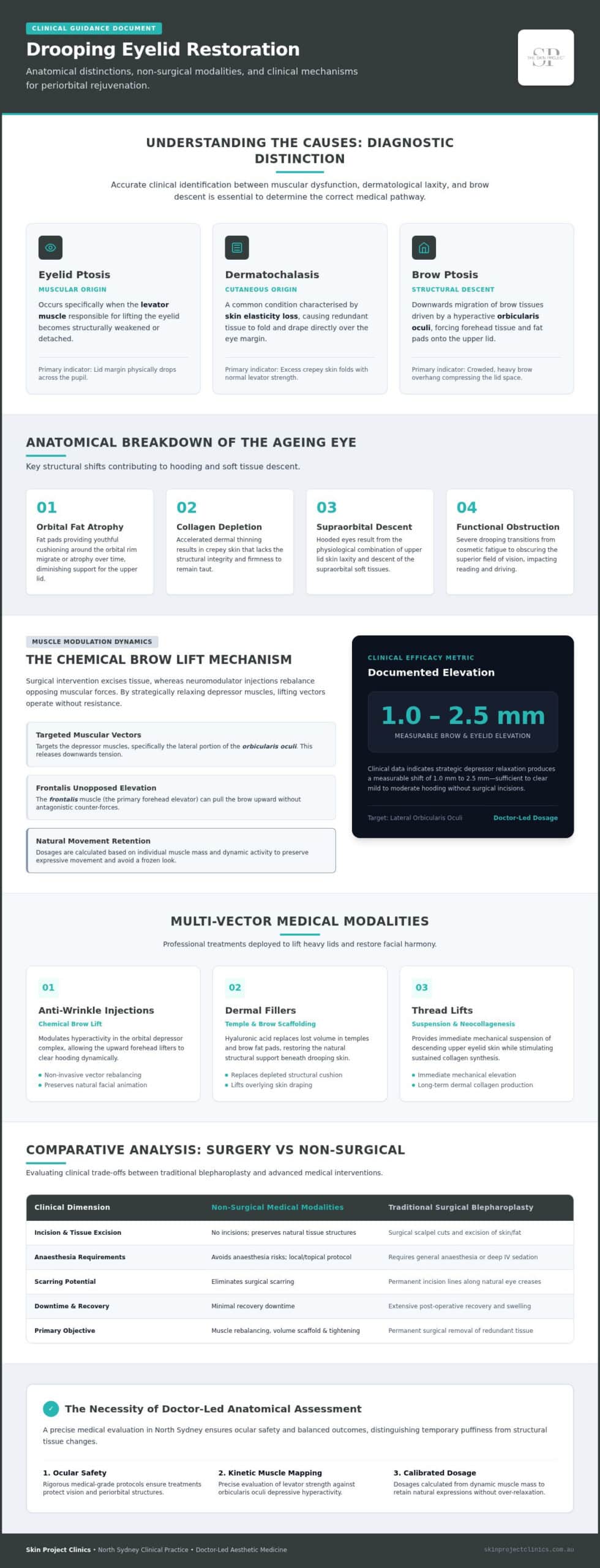
Identifying the root cause of eye sagging is the first step toward effective restoration. Many patients arrive at our North Sydney clinic concerned about heavy lids, yet the underlying issue often stems from one of two distinct clinical conditions. The first is eyelid ptosis, which occurs when the levator muscle responsible for lifting the lid becomes weak or detached. The second, more common condition is dermatochalasis, where the skin simply loses elasticity and begins to fold over the eye margin. Distinguishing between these requires a professional eye.
Brow position also plays a pivotal role in how the upper lid appears. As we age, the brow often migrates downwards, a process known as brow ptosis. This descent forces the forehead skin and fat pads onto the upper eyelid, creating a crowded, heavy appearance. The orbicularis oculi, a circular muscle around the eye, acts as a powerful depressor that pulls the brow and lid area downwards. If this muscle is hyperactive, it can exacerbate the look of sagging, making a drooping eyelid treatment without surgery a complex, multi-vector challenge.
Anatomical Factors of the Ageing Eye
Structural changes beneath the skin significantly influence the periorbital area. Over time, the fat pads that provide a youthful cushion around the orbital rim begin to migrate or atrophy, leading to a loss of support for the upper lid. Simultaneously, collagen depletion causes the skin to become crepey and thin, losing the structural integrity needed to remain taut. Hooded eyes are a clinical combination of upper lid skin laxity and the structural descent of the supraorbital soft tissues.
The “Tired Look” vs. Medical Concerns
For most, the primary concern is aesthetic. Looking fatigued or unapproachable despite being well-rested can take a heavy psychological toll on professional and social confidence. However, severe drooping can transition from a cosmetic nuisance to a functional medical concern. When excess skin or a low lid margin begins to obscure the superior field of vision, it may interfere with daily activities like driving or reading. A doctor-led assessment is essential to differentiate between temporary puffiness, which may be related to lifestyle factors, and permanent structural changes that require clinical intervention.
Non-Surgical Modalities: Anti-Wrinkle Injections and Dermal Fillers
Addressing the upper facial muscles is a cornerstone of drooping eyelid treatment without surgery. While surgical intervention focuses on the excision of tissue, injectable treatments rebalance the muscular forces and structural support of the periorbital region. By modulating the activity of specific muscles, we can influence the height and shape of the brow, which in turn elevates the eyelid skin. This multi-vector approach allows for a refreshed appearance without the trauma of an incision.
The Chemical Brow Lift Explained
The “Chemical Brow Lift” is a precise technique that targets the depressor muscles, primarily the lateral portion of the orbicularis oculi. When these muscles are relaxed with anti-wrinkle injections, the frontalis muscle, the primary forehead lifter, can pull the brow upwards without resistance. Clinical data indicates this strategic relaxation can achieve a measurable elevation of 1.0 mm to 2.5 mm. This subtle shift is often sufficient to clear mild to moderate hooding. At our practice, we prioritise a natural result, ensuring the patient retains expressive movement while achieving a more “open” appearance. The American Academy of Ophthalmology notes that such interventions are particularly effective for acquired sagging where muscle dynamics play a key role. We avoid the “frozen” look by calculating dosages based on individual muscle mass and dynamic activity, ensuring the lift remains undetectable to the untrained eye.
Temple and Brow Volumisation
Volume loss in the upper face is a frequently overlooked contributor to eyelid descent. As we age, hollowing in the temples and the atrophying of fat pads along the brow bone cause the overlying skin to lose its structural scaffolding. This leads to the skin draping downwards over the eyes. By using hyaluronic acid dermal fillers, we can restore this lost volume, effectively “tucking” or lifting the excess skin back into its original position.
Safety is paramount when treating the periorbital area. The temple and brow regions are anatomically complex, containing the ophthalmic artery and other critical vessels. A doctor-led approach ensures that these fillers are placed with medical precision to avoid vascular compromise. This structural restoration provides a stable foundation for the brow, preventing the lateral eye from appearing heavy or pulled down. For those seeking a tailored approach, a clinical consultation for dermal fillers can determine the ideal placement for your specific facial structure. These treatments typically offer longevity ranging from 6 to 18 months, depending on the product used and individual metabolic factors.
Advanced Clinical Solutions: Thread Lifts and Non-Surgical Blepharoplasty
While muscle relaxation and volume restoration address dynamic and structural hollowing, advanced drooping eyelid treatment without surgery often requires mechanical suspension or direct skin contraction. These physician-led procedures offer a middle ground for patients with moderate laxity who aren’t ready for the risks associated with surgical blepharoplasty. By avoiding general anaesthesia and hospital theatre fees, patients can achieve significant rejuvenation with reduced downtime. These medical-grade solutions focus on the structural integrity of the periorbital tissues.
Thread Lifting for Brow Elevation
Thread lifting utilises absorbable polydioxanone (PDO) sutures to provide immediate structural elevation. Our doctors employ specific vectoring techniques to physically lift the brow tail and temporal region, which effectively “opens” the eye area. Beyond the initial mechanical lift, these threads trigger a biological response. As the body naturally absorbs the PDO material over approximately six months, it replaces the threads with a matrix of new collagen. This secondary support helps maintain the lift for 12 to 18 months, depending on individual tissue quality. For those who wish to further enhance this structural lift with aesthetic precision, looking at the work of specialised brow clinics like Permanence.no can demonstrate how expert shaping completes the rejuvenation. Patients in North Sydney often prefer this method because the recovery is swift. You can expect mild swelling or pinpoint bruising for about 48 hours, allowing for a discreet return to professional duties.
For patients where “crepey” skin texture is the primary concern, non-surgical blepharoplasty focuses on dermal contraction. Energy-based devices, such as plasma technology or fractional lasers, create controlled micro-injuries in the epidermis. This process forces the skin to tighten and contract as it heals. Integrating Fraxel laser treatment into a rejuvenation plan improves both the texture and thickness of the eyelid skin. It addresses the fine lines that contribute to the appearance of hooding, resulting in a smoother, more youthful lid surface.
Combining these modalities creates a comprehensive “non-surgical bleph” result. We might use thread lifting to establish the correct brow position and then apply laser resurfacing to refine the lid skin. This approach addresses multiple anatomical layers simultaneously. Because there are no surgical incisions, the risk of permanent scarring is virtually eliminated. It’s an ideal pathway for those seeking a refreshed look without the 14-day recovery period typical of invasive surgery. Each treatment plan is customised to the patient’s specific degree of dermatochalasis and anatomical needs.
Comparing Options: Surgery vs. Non-Surgical Treatments
Choosing between surgical and non-surgical paths requires balancing the desired outcome with your tolerance for risk and downtime. While surgery offers a permanent reduction of tissue, it carries the potential for an “over-hollowed” appearance if too much fat or skin is removed. This can inadvertently age the eye area by creating a skeletal look. In contrast, a drooping eyelid treatment without surgery focuses on restoration and subtle elevation. This approach preserves the natural fat pads and structural integrity of the periorbital region, ensuring the result looks refreshed rather than “operated on.”
The recovery differential is significant. Surgical blepharoplasty typically necessitates 10 to 14 days of moderate swelling and bruising, with tissues taking up to 12 weeks to settle fully. Non-surgical alternatives generally require only a weekend of recovery or, in the case of energy-based treatments, 5 to 7 days for superficial crusting to shed. Beyond downtime, the risk profiles differ. Surgery involves permanent scarring and the rare risk of nerve damage. Non-surgical risks are generally temporary and manageable, such as minor swelling or transient injection effects that resolve within days.
Who is the Ideal Candidate for Non-Surgical Treatment?
Ideal candidates are those presenting with mild to moderate skin laxity or early-stage brow descent. If the eyelid skin is severely “curtaining” and obstructing the visual field, a surgical referral may be the more appropriate clinical recommendation. Non-surgical options are best suited for patients seeking subtle, natural-looking rejuvenation rather than a dramatic transformation. We also frequently treat patients who have medical contraindications for general anaesthesia, making clinical, non-invasive protocols the safer and more accessible choice.
The Longevity Factor
Maintaining results requires a commitment to a professional clinical schedule. Integrating anti-wrinkle injections into a long-term plan ensures the brow remains elevated and prevents the deepening of dynamic folds. Regular treatments offer cumulative benefits, as consistent collagen stimulation from threads or lasers improves the baseline quality of the skin over time. While non-surgical results are not permanent, they allow for incremental adjustments as the face continues to age naturally. If you are ready to explore a personalised rejuvenation plan, you can book a clinical consultation with our experienced medical team in North Sydney.
Your Clinical Consultation at Skin Project Clinics North Sydney
Every effective drooping eyelid treatment without surgery begins with a comprehensive diagnostic evaluation. At our North Sydney centre, we believe that aesthetic restoration must be grounded in clinical precision. Our doctors meticulously assess the relationship between your forehead musculature, the orbital rim, and the eyelid margin. This doctor-led approach is vital for ocular safety, ensuring that any proposed intervention respects the complex anatomy surrounding the eyes. By identifying whether your concerns stem from skin laxity, muscle dynamics, or volume loss, we can provide a medically sound recommendation that prioritises your long-term health.
Personalised treatment planning is the hallmark of our ethical aesthetic practice. We don’t subscribe to generic protocols; instead, we map the unique vectors of your face to determine the most effective path to rejuvenation. This bespoke strategy ensures that results remain natural and balanced, avoiding the “overdone” appearance often associated with less specialised providers. Our commitment to professional integrity means we offer transparent advice on what non-surgical modalities can realistically achieve for your specific anatomical structure. We focus on subtle, sophisticated restoration that aligns with your individual aesthetic goals.
Expert Care Near North Sydney
Our clinic is a physician-owned institution that provides a calm, clinical environment for patients across the Lower North Shore. We regularly serve professionals from Crows Nest, Neutral Bay, and surrounding suburbs who seek elite medical expertise in a supportive setting. Recognising the time constraints of our patients, we offer Saturday appointments to accommodate busy schedules. This allows you to undergo a thorough clinical assessment and subsequent treatments without the pressure of a mid-week professional calendar. Our facility is designed to feel like a high-end medical practice, ensuring you feel secure and well-informed at every stage of your journey.
Next Steps to Refresh Your Look
Preparing for your first visit involves a clear understanding of your medical history and your primary aesthetic objectives. During the consultation, our cosmetic doctors will discuss your concerns in detail, whether you’re frustrated by hooded lids or a perpetually tired appearance. We’ll review any previous aesthetic procedures and current health considerations to build a safe and effective treatment plan. This methodical approach ensures there are no surprises, allowing you to move forward with quiet confidence in your chosen path.
Taking the first step toward a more “awake” and refreshed version of yourself is straightforward. You can easily manage your booking through our digital portal to find a time that suits your needs. Organise your consultation with our cosmetic doctors today to receive a professional anatomical assessment and begin your personalised drooping eyelid treatment without surgery.
Restoring Your Natural Vitality with Clinical Precision
Achieving a refreshed, “awake” appearance doesn’t require the invasiveness of traditional surgery. We’ve explored how identifying the anatomical cause of sagging, whether it’s skin laxity or brow descent, is the foundation of any successful restoration. By combining medical-grade solutions like thread lifting and energy-based skin tightening, you can achieve structural elevation with minimal downtime. Selecting a drooping eyelid treatment without surgery allows you to maintain your natural facial character while addressing the signs of fatigue that no longer match your internal energy.
As a doctor-led medical clinic centrally located in North Sydney, we specialise in non-surgical blepharoplasty tailored to your unique anatomy. Our focus remains on clinical safety and subtle, ethical outcomes that respect your facial structure. You don’t have to settle for looking perpetually tired when professional, physician-owned solutions are within reach. We invite you to Book Your Eye Rejuvenation Consultation in North Sydney to begin your journey toward a brighter, more vibrant reflection. You deserve to look as capable and energised as you feel.
Frequently Asked Questions
How long do non-surgical drooping eyelid treatments last?
The longevity of results depends on the clinical modality selected during your consultation. Neuromodulating injections typically provide a lift for three to six months as muscle activity gradually returns. In contrast, thread lifting offers immediate mechanical suspension with secondary collagen support that can last between 12 and 18 months. Energy-based treatments like laser resurfacing produce structural changes in the skin that may persist for several years, though natural ageing continues to progress over time.
Is the treatment for heavy eyelids painful?
Patient comfort is a priority in our medical environment. Most procedures for heavy eyelids involve minimal discomfort because we use medical-grade numbing agents. We apply high-strength topical anaesthetic creams before laser or injectable treatments to desensitise the skin. For more involved procedures like thread lifting, a local anaesthetic is administered to ensure the area is completely numb. Most patients describe the sensation as a mild pressure or a slight pinching rather than significant pain.
Can anti-wrinkle injections really lift a drooping eyelid?
Strategically placed injections can effectively function as a drooping eyelid treatment without surgery by rebalancing facial muscles. By relaxing the muscles that pull the brow downwards, such as the lateral orbicularis oculi, the forehead’s lifting muscles can work without opposition. This creates a subtle upward shift of the brow, which reduces the appearance of skin hooding over the eyes. It’s an ideal solution for patients with mild descent who want to avoid invasive measures.
What is the difference between a surgical and non-surgical blepharoplasty?
Surgical blepharoplasty is an invasive procedure involving incisions to excise excess skin and reposition fat pads under general anaesthesia. Non-surgical blepharoplasty, however, utilises medical technology to contract the skin or mechanically lift the tissues. Our clinic focuses on non-surgical restoration, which avoids permanent scarring and the long recovery periods associated with theatre-based surgery. While surgery is permanent, non-surgical options offer a safer, adjustable alternative for those seeking natural-looking rejuvenation without the associated surgical risks.
How much downtime is required after a thread lift for eyelids?
Downtime following a thread lift is considerably shorter than surgical alternatives. Most patients experience mild swelling, redness, or pinpoint bruising at the entry sites for approximately 48 hours. Many of our North Sydney professional clients find they can return to their daily routines within two days of the procedure. We provide specific aftercare instructions to manage these temporary effects, ensuring a discreet recovery that doesn’t interfere with your social or professional commitments.
Are there any risks with non-surgical eye rejuvenation?
While non-surgical eye rejuvenation is generally lower risk than surgery, clinical procedures always carry some potential for side effects. Common reactions include temporary swelling, bruising, or mild asymmetry as the tissues settle. More significant risks, such as vascular compromise, are extremely rare when treatments are performed by experienced medical doctors. Our physician-led approach ensures that every procedure is conducted with anatomical precision and a deep understanding of ocular safety to minimise these possibilities.
How many sessions will I need to see a visible lift?
The number of sessions required varies based on the chosen treatment and the degree of skin laxity. Injectable lifts and thread lifting often produce visible results after a single appointment. For energy-based skin tightening or laser resurfacing, a series of one to three sessions may be recommended to achieve optimal skin contraction and collagen synthesis. Your doctor will outline a personalised clinical timeline during your initial assessment to ensure your expectations align with the physiological healing process.
Can I drive home after my eyelid treatment at your North Sydney clinic?
You are typically able to drive yourself home following your appointment at our North Sydney clinic. Because these treatments are performed under local anaesthetic or topical numbing rather than general anaesthesia, your cognitive functions and reaction times remain unaffected. Some patients may experience mild, temporary blurring if topical ointments are used near the eye during laser treatments, but this usually resolves quickly. We recommend discussing your specific procedure with our medical team to confirm your post-treatment plan.