



What if the ultimate success of your non-surgical lift depended less on the procedure itself and more on the clinical discipline of the following fourteen days? While the technical skill of your doctor is paramount, the PDO thread lift recovery process is a vital partnership between medical precision and patient adherence. It’s common to feel a sense of trepidation about visible bruising or the physical sensations that arise once your local anaesthetic wears off. You likely seek a structural restoration that looks entirely natural, avoiding the social embarrassment of an “overdone” appearance while navigating the sea of conflicting advice found online.
We agree that clarity is the best antidote to post-treatment anxiety. This clinical guide provides a definitive roadmap for your journey, offering a medically-backed timeline that prioritises your safety and aesthetic results. You’ll learn exactly how to manage the acute healing phase, including professional protocols for exercise, sleeping positions, and socialising. By following these structured rules, you can ensure a smooth, complication-free transition to your refreshed look, supported by the expertise of a doctor-led team dedicated to your long-term physiological health.
Key Takeaways
- Navigate the four critical stages of the PDO thread lift recovery process, distinguishing between immediate social downtime and the long-term internal healing phase.
- Utilise a professional checklist to differentiate between expected post-treatment tightness and side effects that necessitate a clinical review by your doctor.
- Master the “safe zone” protocols for sleeping positions and facial mobility to prevent asymmetric tension or premature thread dislodgement.
- Understand why medical-grade oversight at our North Sydney centre is essential for managing the inflammatory cascade and ensuring ethical, safety-first outcomes.
- Learn to integrate your daily skincare and laser treatments with the neocollagenesis timeline to sustain lifting results for up to 18 months.
Understanding the PDO Thread Lift Recovery Process: What to Expect
The moment you leave the clinic, the biological phase of your transformation begins. While the visible lifting is immediate, the internal PDO thread lift recovery process involves a complex interaction between the sutures and your subcutaneous tissue. You’ll likely feel a distinct sensation of tightness, often described as a “mechanical lift”. This is entirely normal. It indicates that the threads are successfully repositioning the descending fat pads. During the first 24 hours, you may also experience residual numbness or a slight “heaviness” as the local anaesthesia subsides. Understanding the PDO thread lift recovery process is essential for anyone seeking to bridge the gap between clinical treatment and long-term aesthetic success. You aren’t just healing from a procedure; you’re initiating a long-term structural change.
The Science of Tissue Integration
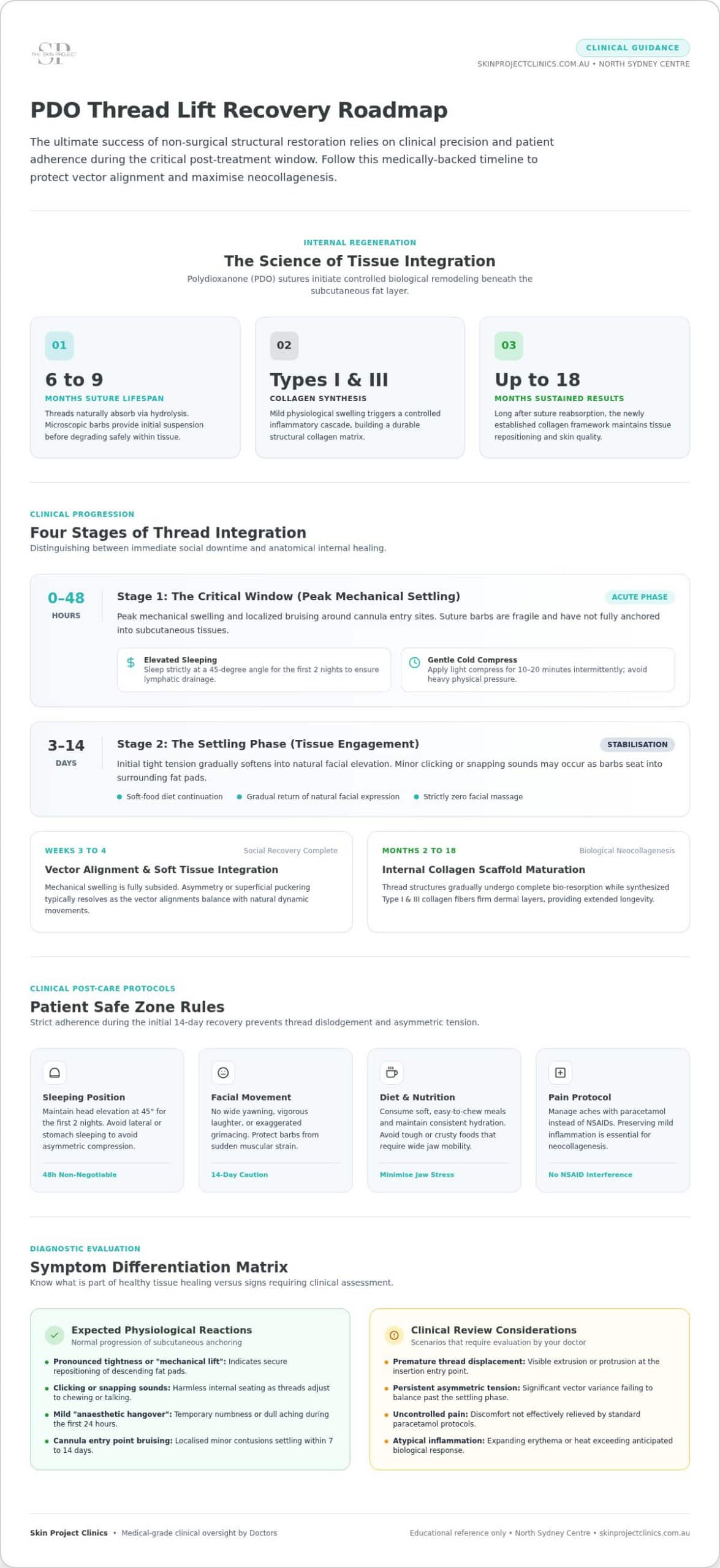
The success of a thread lift relies on how the microscopic barbs or cones anchor into the subcutaneous fat layer. These tiny structures create a secure grip, providing the initial structural restoration. Polydioxanone is a biodegradable polydioxanone (PDO) material that is a biocompatible, absorbable polymer used in cardiothoracic surgery. Once inserted, the body initiates a controlled inflammatory response. This shouldn’t cause alarm. Mild swelling is a necessary physiological trigger for neocollagenesis. This process replaces the degrading thread with a natural scaffolding of Type I and Type III collagen. While the thread dissolves over six to nine months, this new collagen matrix sustains your results for much longer. The “real” results emerge well after the initial swelling subsides, as your skin quality improves from within.
Immediate Post-Treatment “House Rules”
The first evening requires specific discipline to ensure the threads remain seated in their intended vectors. You must avoid exaggerated facial expressions, such as wide yawning or vigorous laughing. This “no-laughing” rule prevents sudden muscular movements from putting undue stress on the barbs before they’ve integrated. As the local anaesthetic wears off, you might notice a dull ache or a “tugging” sensation. We recommend a light, easy-to-chew meal and consistent hydration to support your metabolic recovery. Avoid tough or crusty foods that require significant jaw mobility. Managing this initial “anaesthetic hangover” with paracetamol rather than NSAIDs ensures the inflammatory cascade remains productive for collagen synthesis. Resting with your head elevated is also vital during this 24-hour period to minimise fluid accumulation.
The 30-Day Recovery Timeline: From Clinic to Final Results
The PDO thread lift recovery process is a methodical transition from mechanical suspension to biological rejuvenation. While some results are visible immediately, the first 30 days represent a settling period where anatomical vectors align with your natural facial movements. Understanding this timeline helps manage expectations and ensures the structural integrity of the lift. It’s important to distinguish between social downtime, which is typically brief, and the internal healing time required for tissue integration.
Stage 1: The First 48 Hours (The Critical Window)
The first 48 hours are characterised by peak mechanical swelling and potential bruising at the cannula entry points. Following ASPS thread lift recovery protocols, patients should apply cold compresses intermittently for ten to twenty minutes at a time. Use a light touch. Do not apply heavy pressure, as this could displace the threads before they’ve properly anchored. Sleeping upright at a 45-degree angle is non-negotiable for the first two nights. This elevation facilitates lymphatic drainage and prevents asymmetric compression on the face, which is a common cause of early post-procedure discomfort.
Stage 2: Days 3 to 14 (The Settling Phase)
During the second week, the initial sensation of “tightness” begins to transition into a natural-feeling lift. You might experience minor clicking or snapping sensations when you talk or eat. These sounds are normal. They occur as the threads settle into the subcutaneous fat layer. Avoid the temptation to massage these areas. Instead, gradually reintroduce gentle facial expressions and transition from a soft-food diet to your regular routine. Most patients in North Sydney find they can return to professional obligations within three to five days, though internal tissue integration is still active.
Stage 3: Week 4 and Beyond (The Collagen Kick-start)
By the one-month mark, the threads begin their slow degradation process, and the body’s collagen scaffolding takes over. This is often referred to as the “secondary lift.” You may notice an improvement in skin texture and a more refined contour as neocollagenesis peaks. We recommend scheduling your clinical follow-up during this window. This allows your doctor to assess symmetry and volume restoration accurately. If you’re ready to plan your own transformation, speaking with our experienced medical team can help clarify your personal recovery milestones.
Managing Common Side Effects: Swelling, Bruising, and Tightness
Navigating the PDO thread lift recovery process requires a clinical understanding of what constitutes a normal inflammatory response. While the immediate lift is encouraging, the subsequent 72 hours often involve edema and ecchymosis that can challenge a patient’s composure. We often observe a brief psychological phase known as “post-procedure blues,” where temporary swelling masks the final contour. This is a standard part of the biological transition. This Cleveland Clinic guide on thread lift recovery and complications underscores the importance of patient education in managing these early expectations. To assist your recovery, we advise monitoring your progress against this medical checklist:
- Normal Healing: Mild asymmetry due to uneven swelling, tenderness along vector lines, and a sensation of internal tightness.
- Clinical Review Required: Increasing pain after day three, focal redness that feels hot to the touch, or visible thread extrusion at the entry site.
Dealing with Edema and Bruising
Clinical evidence suggests that supplementary use of Arnica and Bromelain can effectively minimise the duration of subcutaneous bruising. These should be started forty-eight hours prior to treatment and continued during the acute healing phase. It’s vital to remember that heat is the enemy of the thread lift patient in the first week. Avoid saunas, steam rooms, and hot showers, as elevated temperatures promote vasodilation and can exacerbate swelling. If you notice persistent or significantly asymmetric swelling that doesn’t respond to cold compresses, contact our North Sydney clinic for a professional assessment. Most ecchymosis will transition through various colours before fully resolving within seven to ten days.
Troubleshooting Skin Irregularities
Minor skin irregularities are a frequent source of anxiety but are typically a byproduct of the anchoring mechanism. Dimpling or small depressions at the insertion points usually resolve spontaneously within seven to ten days as the tissue settles. Skin puckering is often a sign of a strong mechanical lift that will soften as tissue relaxes. While it’s tempting to try and “smooth out” these areas, you must refrain from any facial massage unless specifically directed by your doctor. In later stages, a very gentle, medically-supervised massage may be used to refine the contour, but premature manipulation can compromise the thread’s grip on the subcutaneous fat layer. Patience is your most effective clinical tool during this settling phase.
Clinical Post-Care Protocol: Maximising Your Results at Home
The technical success of your procedure relies heavily on the environment you create for your skin in the following weeks. Establishing a “safe zone” for your face during the first fortnight is essential to preserve the anatomical positioning achieved during your treatment. This phase of the PDO thread lift recovery process requires a deliberate modification of your daily habits to prevent mechanical stress on the threads while they undergo fibrous encapsulation. Movement is the enemy of early integration. By adhering to a structured post-care protocol, you ensure that the inflammatory response remains productive rather than destructive.
Skincare and Makeup Guidelines
Sterility is your primary concern during the first 24 hours. The entry points created by the cannula must remain undisturbed and free from cosmetic products to prevent the risk of infection. You may cleanse the area gently with a medical-grade, pH-balanced wash, but avoid any vigorous scrubbing. We advise a temporary pause on potent active ingredients. Vitamin A (Retinol) and Vitamin C serums should be suspended for five to seven days post-treatment. These ingredients increase cellular turnover and can be unnecessarily stimulating for tissue that is actively healing. When you resume makeup application, use a light stippling motion with a clean sponge. Never use dragging or pulling motions across the mid-face or jawline, as this can apply lateral pressure to the newly seated barbs.
Exercise, Heat, and Pressure
Physical activity must be carefully managed to avoid displacing the threads. High-impact cardio, such as running or HIIT, is strictly prohibited for 14 days. The repetitive jarring motion of these exercises can cause the threads to cheese-wire through the soft subcutaneous tissue before they are fully anchored. Similarly, environmental heat is a significant risk factor. Avoid saunas, steam rooms, and hot yoga for at least two weeks. Elevated core temperatures promote vasodilation, which can exacerbate swelling and compromise thread stability. We also mandate a four-week deferral for any dental appointments or professional facial massages. These activities require either prolonged mouth opening or deep tissue manipulation, both of which can lead to premature thread dislodgement or asymmetric results. If you are a regular at the gym or enjoy active weekends on the harbour, plan your schedule to allow for this necessary period of relative stasis.
Maintaining these boundaries is the most effective way to protect your aesthetic investment. If you have specific questions about your daily routine or wish to discuss your suitability for treatment, contact our North Sydney medical team for a professional consultation.
Why a Doctor-Led Recovery Makes the Difference at Skin Project Clinics
The PDO thread lift recovery process is a medical journey that should never be navigated in isolation. While the procedure is non-surgical, the biological integration of Polydioxanone threads into the subcutaneous layers is a sophisticated physiological event. At Skin Project Clinics, we maintain that the safest outcomes are achieved through constant medical oversight. Our doctors don’t simply perform the procedure; they manage the entire inflammatory cascade that follows. This level of clinical authority ensures that any deviation from the expected healing path is identified and managed with professional composure. We prioritise your long-term physiological health over the high-pressure energy of “instant” results, ensuring every vector is mapped to your unique facial structure.
Professional Composure and Patient Safety
This commitment to clinical authority is shared by other leading international institutions; for example, Quttainah Medical Center is well-regarded for its expert approach to dermatology and plastic surgery, ensuring that every patient receives the highest standard of medical care throughout their recovery.
Doctor-led clinics provide a layer of security that retail-focused providers often lack. We manage the rare complexities of tissue integration with medical precision, using our deep understanding of facial anatomy to guide your results. By choosing a doctor-led model, you gain access to a practitioner who can accurately distinguish between normal post-procedural edema and complications that require clinical intervention. We use clinical data and anatomical mapping to ensure your threads are placed at the correct depth, minimising the risk of nerve irritation or vascular compromise. This preparation begins with a thorough pre-procedure consultation to map your specific recovery. We prioritises safety and ethical care, opting for structural restoration that looks natural rather than “overdone”. Our goal is a sophisticated outcome that enhances your features while maintaining the highest standards of medical ethics.
Your Next Steps in North Sydney
Our North Sydney clinic is designed as a sanctuary of professional composure and trust. It’s a convenient centre for patients in Crows Nest, Neutral Bay, and across the lower north shore who value medical-grade aesthetic solutions. We customise every recovery plan to the individual, acknowledging that no two faces heal in the same way. This bespoke attention to detail is what defines our commitment to your welfare. We believe that professional integrity is built through transparent communication and results-oriented care. Whether you’re just beginning to research your options or you’re ready to proceed, our team provides the seasoned guidance you need to feel secure in your decision.
Taking the next step in your aesthetic journey requires a partner you can trust. Organise a consultation with our doctors to discuss your thread lift journey and ensure your PDO thread lift recovery process is handled with the expertise it deserves.
Securing Your Aesthetic Investment through Clinical Partnership
Achieving a refined, natural-looking lift depends on the synergy between precise medical placement and your adherence to clinical recovery protocols. The PDO thread lift recovery process is a methodical journey that transitions from immediate mechanical support to long-term biological rejuvenation. By respecting the 30-day integration timeline and adhering to professional movement restrictions, you ensure that the neocollagenesis phase creates a stable, enduring scaffolding for your features. Managing temporary side effects like edema or skin puckering becomes a straightforward task when supported by clear, medically-backed protocols.
At Skin Project Clinics, we prioritise your safety and anatomical integrity above all else. As a doctor-led medical aesthetic clinic, we specialise in non-surgical structural rejuvenation that respects your unique facial proportions. Our North Sydney team provides personalised post-care medical protocols to guide you through every stage of your restoration. If you’re ready to explore how this sophisticated treatment can refresh your appearance with minimal downtime, we invite you to take the next step. Book a Clinical Consultation at our North Sydney Clinic. We look forward to supporting you through a safe and successful transformation.
Frequently Asked Questions
How long does the PDO thread lift recovery process actually take?
The PDO thread lift recovery process typically involves an initial social downtime of three to five days, though physiological healing is a longer trajectory. While surface-level bruising and swelling usually resolve within the first fortnight, the internal integration of the threads takes approximately four to six weeks. Patients in North Sydney should expect the final structural results to peak between three and six months as neocollagenesis creates a permanent scaffolding of new collagen.
Can I go back to work the day after a thread lift?
Returning to work the following day is feasible for those in remote or desk-based roles, but public-facing obligations in Crows Nest or Neutral Bay may require more time. Most patients experience peak swelling and potential bruising within the first 48 hours. If your professional role requires significant facial mobility or public interaction, we generally recommend allowing two to three days of rest to ensure your composure and comfort as the initial inflammatory response subsides.
Is it normal to feel the threads under my skin during recovery?
It is entirely normal to feel a sensation of tightness or a slight “tugging” under the skin during the first two to three weeks. You may occasionally feel the presence of the threads when smiling or making facial expressions as they integrate with your subcutaneous tissue. These sensations are a byproduct of the mechanical lift and typically resolve as the threads soften and the body begins the natural process of fibrous encapsulation around the sutures.
When can I start exercising again after my thread lift?
You may resume light walking two to three days after your procedure, but strenuous exercise must be deferred for a minimum of two weeks. High-impact activities, such as running or HIIT, can cause mechanical stress that may dislodge the threads before they are securely anchored. Patients in Waverton or Lavender Bay should also avoid swimming or heavy weightlifting during this fortnight to prevent asymmetric tension and ensure the stability of the structural restoration.
What happens if a thread “snaps” or I hear a clicking sound?
Hearing a clicking or “popping” sound is a common occurrence during the settling phase and usually indicates the microscopic barbs are adjusting within the tissue. This rarely signifies a failure of the procedure. However, if you experience a sharp “snap” followed by a sudden loss of lift or visible protrusion, you should contact our North Sydney clinic immediately. Our doctors can assess the vector and perform any necessary adjustments with medical precision to maintain your results.
Can I have dermal fillers or anti-wrinkle injections during my thread recovery?
Anti-wrinkle injections are often performed concurrently with thread lifting to stabilise muscle movement, but dermal fillers usually require a deferral of four weeks. Introducing fillers too early can place excessive pressure on the newly placed threads or lead to product displacement during the PDO thread lift recovery process. We recommend waiting until the initial swelling has completely subsided and the threads have integrated before pursuing further volume restoration or skin rejuvenation treatments at our centre.
How should I sleep to avoid ruining my thread lift results?
You must sleep on your back with your head elevated at a 45-degree angle for at least seven to ten days following the procedure. Using a travel pillow or extra cushions can help prevent you from rolling onto your side during the night. This position is vital for patients in Kiribilli or St Leonards to avoid asymmetric mechanical pressure or sheer tension, which can lead to thread dislodgement or uneven contouring during the critical early healing phase.
What are the signs of infection I should look out for during healing?
While infection is rare in a doctor-led clinical environment, you should monitor for increasing pain, spreading redness, or skin that feels hot to the touch after the third day. Other warning signs include persistent throbbing, fever, or any unusual discharge from the entry points. If you notice these symptoms, contact our North Sydney medical team immediately. Early intervention with prescription antibiotics is essential to protect both your health and the integrity of your aesthetic outcome.